
Casino Floor Automation: How RFID Tables Enable Smart Operations
Defining Smart Casino Operations
The concept of a smart casino floor extends beyond deploying individual technology products. It represents an operational model where data flows continuously from gaming devices to centralized systems, enabling real-time decision-making, automated workflows, and predictive analytics. RFID-equipped gaming tables serve as the foundational data layer for this model, generating the transaction-level detail that makes floor-wide automation possible.
Traditional casino operations rely heavily on manual observation, paper-based processes, and periodic reporting. Table game performance is assessed through daily shift reports compiled from supervisor entries. Chip inventory is reconciled through physical counts conducted at shift changes. Player behavior is understood through episodic rating entries. Each of these manual processes introduces latency, inaccuracy, and labor cost.
RFID tables replace these manual processes with continuous, automated data streams. The result is a casino floor that operates with the same level of instrumentation and responsiveness that slot floors have enjoyed for decades through TITO systems and server-based gaming.
Automated Table Game Performance Monitoring
Every RFID table generates a real-time data feed that includes hand counts, occupancy rates, average bet sizes, and hold percentages by time interval. This data flows to a floor management dashboard that provides shift managers with an operational view comparable to what slot directors have had for years.
Key performance indicators that become automated through RFID tables include:
– **Hands per hour by table**: Calculated from actual game event timestamps rather than supervisor estimates
– **Table occupancy rate**: Measured by the presence of player-positioned chips, not visual headcounts
– **Average bet per position**: Computed from actual chip values on the table, not rated averages
– **Hold percentage**: Derived from actual buy-in and cash-out transactions matched with RFID chip movements
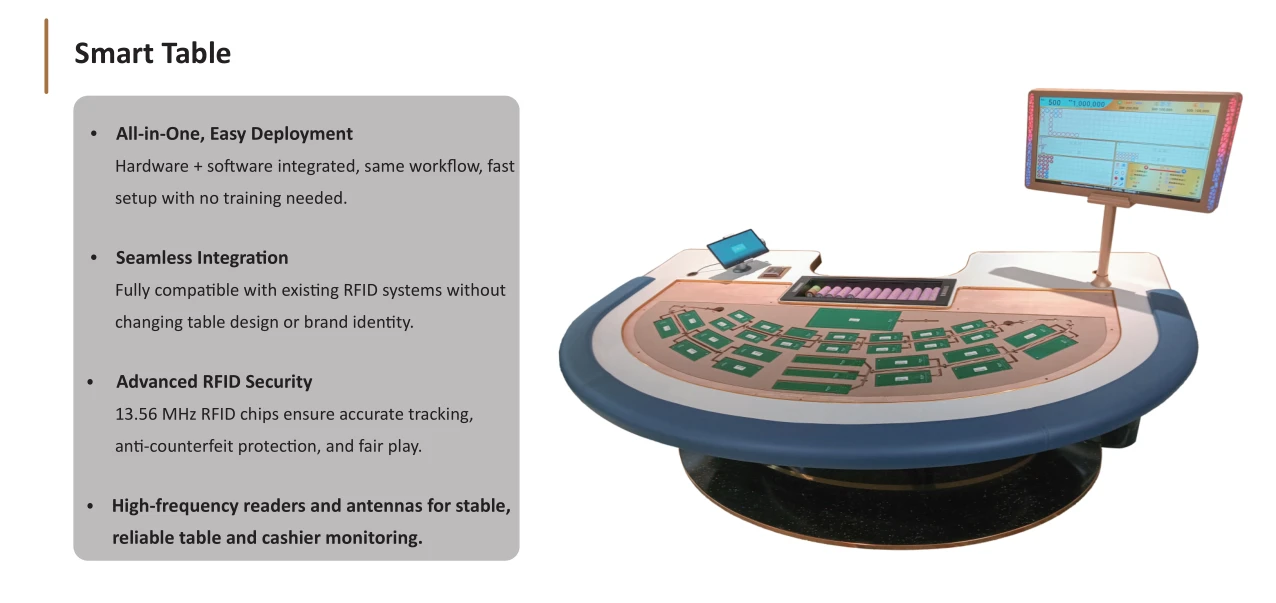
When these metrics are available in real time, floor managers can make immediate operational decisions. A table running below its expected hands-per-hour threshold might indicate a dealer who needs coaching. A table with declining average bets might signal that the game mix or limits need adjustment. A table with zero occupancy for 30 minutes might be better converted to a different game or closed to reduce labor cost.
Dynamic Table Management and Game Optimization
RFID data enables a dynamic approach to table management that static scheduling cannot achieve. By analyzing real-time occupancy and demand patterns, operators can open, close, or reconfigure tables in response to actual player behavior rather than predetermined schedules.
Consider a typical Saturday evening. Traditional operations might staff 20 blackjack tables based on historical demand. RFID data reveals that only 14 tables reach viable occupancy between 8 PM and 10 PM, while baccarat demand exceeds available seats from 9 PM onward. The automated system can recommend—or in advanced implementations, execute—a rebalancing of dealer assignments, converting underperforming blackjack tables to baccarat to capture the demand shift.
This dynamic management capability delivers measurable financial impact. Operators who have implemented RFID-driven table optimization report:
– 8% to 14% improvement in table utilization rates
– 5% to 10% increase in revenue per available table hour
– 12% to 20% reduction in unnecessary dealer labor hours during low-demand periods
Chip Inventory Automation and Reconciliation
Chip management is one of the most labor-intensive aspects of table game operations. Traditional processes require physical chip counts at every shift change, manual reconciliation of fill and credit slips, and periodic full-inventory audits that can take an entire night shift to complete.
RFID tables transform chip management through continuous automated tracking. Every chip on an RFID table is accounted for in real time. When chips move from the casino cage to a table, the transfer is logged through RFID checkpoints. When chips move between tables—through player migration, chip runners, or dealer transfers—each movement is captured.
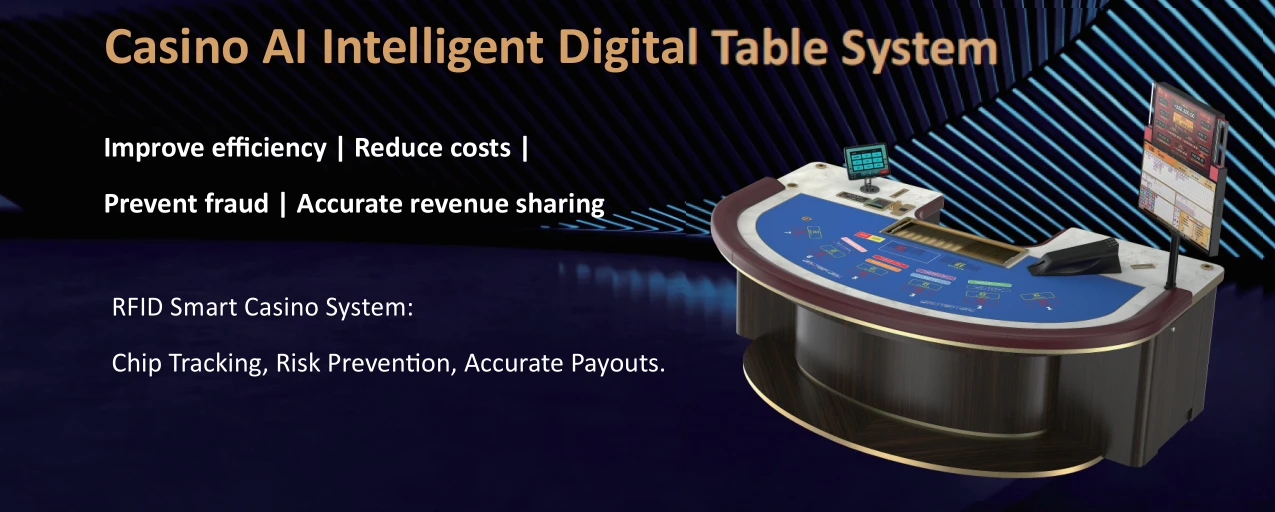
The reconciliation benefits are substantial. Instead of counting chips at shift change, supervisors can verify RFID totals against expected inventory in seconds. Discrepancies trigger immediate alerts rather than being discovered hours later during manual counts. Full-inventory audits that previously required 6 to 8 hours can be completed in under 30 minutes using mobile RFID scanners that read entire chip racks simultaneously.
For high-value denominations, RFID tracking provides an additional layer of security. The system maintains a real-time map of where every $1,000 and $5,000 chip is located—on a specific table, in the cage, or in a chip bank. Any unauthorized movement of high-denomination chips generates an instant alert to surveillance and security teams RFID Casino Table System.
Automated Fill and Credit Processing
The fill and credit process—moving chips between the cage and the table—represents a significant source of operational overhead and potential error. Traditional processes require paper slips, supervisor authorization, runner delivery, and manual verification at both the sending and receiving ends.
RFID systems automate this workflow. When a table’s chip inventory drops below a configured threshold, the system generates an automated fill request routed to the cage. The cage prepares the fill, and each chip is logged by its RFID tag as it enters the delivery container. When the fill arrives at the table, the RFID reader confirms receipt of every chip, and the table’s inventory is updated automatically.
Credits operate in reverse. When a table accumulates excess chips—particularly high-denomination inventory that exceeds the table’s float limit—the system generates a credit request. Chips are placed in a RFID-monitored container, and the cage confirms receipt upon arrival Macaumr RFID Solutions.
Operators who have automated fill and credit processing report:
– 60% to 75% reduction in fill and credit processing time
– Near-elimination of discrepancies between cage and table records
– 40% to 50% reduction in runner trips, as fill quantities are optimized by the system rather than estimated by dealers
Predictive Analytics for Floor Operations
The data generated by RFID tables feeds predictive models that enable proactive floor management. Historical patterns in occupancy, game preference, and bet sizing allow the system to forecast demand by hour, day, and season with meaningful accuracy.
Predictive applications include:
– **Staff scheduling optimization**: Forecasting dealer demand by game type and shift, reducing both overstaffing and understaffing
– **Table limit management**: Recommending minimum bet adjustments based on predicted demand curves, maximizing revenue during peak periods while maintaining occupancy during slower hours
– **Marketing timing**: Identifying optimal windows for promotional activations based on predicted floor traffic patterns
– **Maintenance scheduling**: Predicting table hardware service needs based on usage patterns and reader performance metrics
These predictive capabilities become more accurate over time as the system accumulates historical data. Most operators report meaningful forecasting improvement after 6 to 12 months of continuous RFID data collection, with accuracy improvements of 20% to 35% over manual scheduling methods.
Integration Architecture for Smart Floor Operations
Deploying RFID-enabled smart operations requires a robust integration architecture that connects table-level data with enterprise systems. The typical architecture includes:
– **Edge layer**: RFID readers and antennas at each table, connected to local edge processors that filter and validate raw tag reads
– **Network layer**: High-availability network infrastructure, typically redundant Gigabit Ethernet, connecting edge processors to the data center
– **Processing layer**: Real-time event processing engine that aggregates table data, computes KPIs, and routes alerts
– **Application layer**: Floor management dashboard, CRM integration, cage management system, and reporting tools
– **Analytics layer**: Data warehouse and business intelligence platform for historical analysis and predictive modeling
The critical design consideration is latency. For operational use cases like real-time occupancy monitoring and automated fill processing, end-to-end latency from chip placement to dashboard update should not exceed 5 seconds. For analytical use cases like performance reporting and predictive modeling, near-real-time processing with 1-to-5-minute latency is acceptable.
Frequently Asked Questions
What is the minimum number of RFID tables needed to justify a smart floor deployment?
The financial justification for smart floor operations depends more on table game revenue volume than on the raw number of tables. As a general guideline, properties with 15 or more table game positions generating at least $5 million in annual table game revenue can typically justify the investment. The key driver is the value of improved operational efficiency and comp optimization, both of which scale with revenue volume.
Can RFID table automation work with existing casino management systems?
Most RFID table systems are designed with open APIs that support integration with common casino management platforms, including IGT Advantage, Konami Synkros, and Aristocrat Oasis. Integration typically requires a middleware layer or vendor-provided connectors. The scope and cost of integration varies by platform, so operators should request specific compatibility documentation from the RFID vendor early in the evaluation process.
How does floor automation affect the role of floor supervisors?
RFID-based automation shifts the floor supervisor’s role from data collection to decision-making and player service. Supervisors no longer need to manually record ratings, count chips, or process fill slips. Instead, they focus on game protection, player engagement, and responding to system-generated alerts. Most operators report that supervisors adapt positively to this shift, as the automated tasks were widely recognized as administrative burdens that detracted from their primary responsibilities.
What network infrastructure is required for RFID smart floor operations?
RFID table systems require reliable, low-latency network connectivity. A dedicated VLAN for RFID traffic is recommended, with Gigabit Ethernet connectivity to each table’s edge processor. Redundant network paths are essential for high-availability operations. Wireless connectivity is generally not recommended for the primary data path due to latency and reliability concerns, though it may be acceptable for mobile dashboards and alert delivery to host devices.
How long does it take to deploy RFID smart floor operations across a mid-sized casino?
A phased deployment across 30 to 50 tables typically requires 4 to 6 months, including infrastructure preparation, hardware installation, software configuration, integration testing, and staff training. The critical path is usually integration with existing casino management systems, which can account for 30% to 40% of the total timeline. Operators who allocate dedicated project management resources and establish clear vendor coordination protocols can often compress this timeline by 20% to 30%.